At LensFactory, we offer a range of lens options to fit your lifestyle, prescription, and budget. In this post, we’ll break down the differences between common lens materials and help you decide which one is best for you.
Let’s take a closer look at the most popular prescription lens materials on the market today:
1. Standard Plastic
Best for: Low prescriptions, budget-conscious users
Lightweight and affordable
Good optical clarity
Limited durability and thickness with stronger prescriptions
Worth noting:*Standard plastic is a solid choice if your prescription is mild and you’re looking for the most economical option.
2. Polycarbonate
Best for: Active lifestyles, kids, rimless or semi-rimless frames
Impact-resistant and lightweight
Built-in UV protection
Slightly less optical clarity than CR-39 but more durable
Why it matters:*Polycarbonate lenses are 10x more impact-resistant than standard plastic—perfect for sports, work environments, and everyday wear.
3. Trivex
Best for: Those who want a balance of clarity, durability, and comfort
Even lighter than polycarbonate
Excellent impact resistance
Superior optical clarity
Bonus: Trivex lenses offer better visual clarity and less distortion compared to polycarbonate, while still providing the same rugged durability.
4. High-Index Plastic
Best for: Strong prescriptions, style-conscious users
Ultra-thin and lightweight
Reduces lens thickness for stronger prescriptions
Available with all premium coatings
Why you’ll love it: High-index lenses are the most discreet option. If you hate the “coke bottle” look, these are your best bet for slim, comfortable eyewear.
Here’s a quick guide:
|
Your Needs |
Best Lens Material |
|
Budget-friendly, basic prescription |
Standard Plastic (CR-39) |
|
Active lifestyle, kids’ glasses, rimless frames |
Polycarbonate or Trivex |
|
Strong prescription, thin and light lens desired |
High-Index Plastic |
|
Best overall optical clarity and durability |
Trivex |
LensFactory’s Expert Tip:
Don’t forget the coatings! Regardless of material, adding anti-reflective, scratch-resistant, and blue light coatings can make a huge difference in comfort and performance—especially if you spend time on screens or drive at night.
Choosing the right lens material is about more than just prescription strength. It affects:
How your glasses feel on your face
How clearly you see throughout the day
How durable your lenses are*against drops, scratches, or pressure
At LensFactory, we help you match your lens material to your lifestyle—whether you're a student, athlete, professional, or just someone who wants to enjoy clearer, more comfortable vision every day.
Universal Call to Action
Ready to give your favorite frames a new lease on life?
Discover how easy and affordable it is to replace your lenses with LensFactory. [Visit lensfactory.com](https://lensfactory.com) to get started today!
]]>At LensFactory, we believe smart choices should benefit both your lifestyle and the environment. Let’s explore why lens replacement is the sustainable and budget-friendly solution you've been waiting for.
1. Less Waste in Landfills
Over 4 million pairs of glasses are discarded in the U.S. each year. Most of them still have functional frames. That’s a lot of plastic and metal going straight to the landfill. By keeping your frames and replacing just the lenses, you're reducing your environmental footprint.
2. Reduce the Demand for New Manufacturing
Every new pair of glasses requires raw materials—plastic, metal, screws, nose pads—and energy-intensive production. Choosing lens replacement means you're not contributing to the cycle of overproduction and overconsumption.
3. Sustainable Style
Have a favorite pair of vintage frames or a designer set that fits just right? Don’t toss them. Refresh them with new lenses and extend their lifespan by years. Less buying, less waste—and you still look great.
1. Save Up to 70% Compared to Buying New Glasses
Buying new prescription glasses—especially with specialty lenses or coatings—can cost anywhere from $200 to $800. At LensFactory, replacing your lenses can cost as little as $77, depending on your prescription and lens type.
2. Upgrade Without the Extra Fees
Many optical retailers bake hidden costs into new glasses: designer markups, frame upsells, insurance add-ons, etc. When you send your existing frames to LensFactory, you pay only for the lenses and coatings you actually need.
3. More Customization for Less
Lens replacement lets you select exactly the right features: blue light blocking, anti-reflective coatings, UV protection, photochromic lenses, and more. All without overpaying at a retail store.
Anyone with updated prescriptions but frames they still love
Budget-conscious shoppers tired of overpriced optical stores
Eco-conscious consumers looking to reduce waste
Collectors and style lovers with designer or unique frames
Seniors or students with fixed incomes and evolving vision needs
If any of these sound like you, lens replacement may be your perfect match.
Replacing your lenses with us is simple:
Choose your lenses online – Single vision, progressive, bifocals, and more
Send us your frames – We'll email you a prepaid shipping label
Receive your glasses back, good as new – We’ll professionally fit new lenses in your frames and ship them back, fast
We’re based in the U.S. and use only high-quality, lab-grade lenses for maximum clarity and durability.
In a time when sustainability and affordability are more important than ever, replacing your lenses is a win-win. Keep your favorite frames, reduce your environmental impact, and save big—all with the convenience of ordering from home.
Ready to give your favorite frames a new lease on life?
Discover how easy and affordable it is to replace your lenses with LensFactory. Visit lensfactory.com to get started today!
]]>
This guide will walk you through some DIY methods to try, and when you have to bite the bullet and replace your lenses.
Scratched lenses can occur due to a variety of reasons, including:
Disclaimer! These suggestions should be treated as a last-ditch effort. It's possible that these methods could remove lens coatings or slightly warp your lenses - which would be a problem with correctional lenses.
One common method is using non-abrasive toothpaste:
Another option for removing scratches from lenses is a baking soda paste:
For deeper scratches, glass etching cream might be effective:
If DIY methods don't work or if the scratches are too deep, it's best to seek professional help. Here at LensFactory, we specialize in replacing scratched or damaged lenses in your existing frames.
1) Visit our Lens Selector. Shop by lens material or vision need.
2) Select your lens & customize it.
Choose from lens upgrades like anti-reflective coating, blue light filter, light-responsive/Transitions lenses, tints, and more.
Select our optional Ship Kit during the ordering process. We'll mail you an empty box, so you can send us your frames. Or you can mail the frames yourself, the ship kit isn't required.
3) Checkout! Include a copy of your prescription when you mail us your frames.
Scratched lenses can be frustrating, but with the right methods, you can often fix minor scratches yourself. For deeper scratches, professional services like LensFactory are your best bet. By replacing your lenses, you can enjoy clear vision again without the cost of new frames.
Possibly. A non-abrasive toothpaste can help with very minor scratches by polishing the surface. However, most scratches will probably be too deep for toothpaste to make any noticeable difference.
Baking soda is a mild abrasive that can help with surface scratches. Be aware, it can also remove other coatings on your lenses.
]]>Cue Endless Drive Progressive lenses, designed specifically to:
>> Driving lenses now available in our Occupational Lenses collection!
They are generally designed to offer clarity, reduced glare, and enhanced comfort, making them the ideal choice for anyone looking to optimize their vision on the road.
According to a customer survey, 97% of wearers of Endless Drive Progressive lenses responded that they felt much more comfortable driving during the day and at night.
What makes Endless Drive Progressives the best lenses for driving are expanded visual areas and targeting of night myopia.

Our driving lenses also offer a range of general benefits, like:
Choosing the right lenses can make a world of difference in your driving experience. Here are some factors to consider when looking for good glasses for night driving:
Driving conditions vary throughout the day and night, and having the right lenses is more than helpful. Our lenses are designed to perform exceptionally well in different lighting conditions:
Our lenses offer superior clarity and contrast during the day, reducing glare from the sun and enhancing visibility in bright conditions. You might also consider a gray coating when the weather is sunny and bright. A neutral shade is the least disruptive to your natural color vision.
Additionally, since neutral shades are some of the densest lens colors, they can absorb a higher percentage of light. This means that you’ll receive maximum sun protection and won’t have to squint as much while driving.
With advanced anti-glare technology, our lenses minimize halos and reflections from oncoming headlights, providing clear vision and reducing eye fatigue during nighttime driving, making them the best eye glasses for night driving.
Investing in the right pair of driving glasses offers more than just clear vision. Here's how our lenses can further enhance your driving experience:
A: Polarized lenses are often considered the best lenses for driving as they cut glare, reduce eye strain, and improve overall clarity, making it easier to see the road ahead.
A: Gray tints maintain true color perception, while yellow or amber tints enhance contrast and depth perception, especially in low-light conditions, providing optimal visibility during both day and night driving, particularly when you're searching for good glasses for night driving.
A: Glasses with UV protection, anti-glare features, and a neutral gray tint are ideal for day driving as they reduce glare, shield your eyes from harmful UV rays, and maintain true color perception.
A: Yellow or amber lenses are recommended for night driving as they enhance contrast, reduce glare from oncoming headlights, and improve depth perception, making it easier to see in low-light conditions, proving to be the best eye glasses for night driving.
A: Transition lenses darken or lighten depending on the level of UV exposure. They’re a popular choice for their convenience -- not having to switch back and forth between your everyday glasses and sunglasses.
Most cars have an anti-UV treatment on the windows. Since transition lenses require UV exposure to work, they often don’t change significantly while in a car.
So, while there is no problem wearing light-sensitive lenses while driving, you're not necessarily improving your driving visibility with Transitions lenses.
A: Anti-glare coatings and polarized lenses can help reduce glare from oncoming headlights, improving visibility and reducing eye strain during nighttime driving.
A: Yes, anti-glare glasses effectively reduce reflections and improve vision, especially during night driving, by minimizing distractions caused by glare from headlights and other light sources.
A: Anti-glare glasses with yellow or amber tinted lenses can help reduce halos and glare, improving overall night vision and making it easier to see the road ahead.
A: Polarized lenses and anti-glare coatings can help reduce the intensity of oncoming headlights, allowing for clearer vision and safer driving at night.
A: While night driving glasses can be worn during the day, they may not offer the same level of UV protection as daytime lenses. It's best to opt for lenses with UV protection and a neutral tint for daytime driving.
A: Yes, specialized night driving glasses with anti-glare features and yellow or amber tinted lenses can significantly improve night vision, reducing eye strain and enhancing overall safety.
A: Astigmatism can cause blurry vision, especially at night, making it more challenging to see clearly while driving. Prescription lenses tailored to correct astigmatism can help improve night driving and overall vision.
A: Opting for lenses with anti-glare coatings, yellow or amber tints, and proper prescription can help improve night vision while driving, reducing eye strain and enhancing safety on the road.
When it comes to selecting the best lenses for driving, quality matters. We pride ourselves on delivering excellence in eyewear -- more than 6,000 pairs of lenses pass through our optical labs every day.
We know what "getting it right" looks like.
Our lenses are crafted using advanced technology and premium materials to ensure superior clarity, durability, and performance.
We're the go-to source for online lens replacement of just about any type...and now, driving lenses as well!
]]>As the aviation industry evolves, so must the technology that supports it. We're proud to present our latest innovation: Endless Pilot Progressive Lenses.

Tailored specifically for pilots, these lenses incorporate cutting-edge design and technology to enhance visual performance in the cockpit.
Fly smarter and safer with pilot lenses.

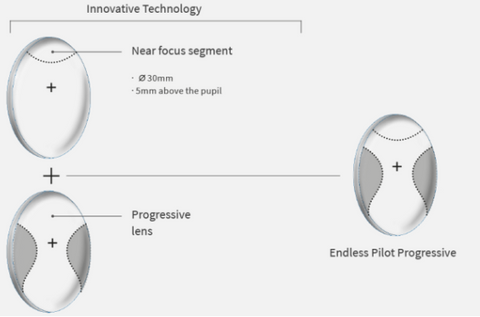
Progressive lenses have long been favored for their ability to correct vision at multiple distances seamlessly. Traditionally, the upper portion of the lens focuses on distant objects, while the lower portion aids in near vision.
However, for wearers who need to focus on near objects through the upper part of the lens, this standard configuration falls short.
Pilot progressive lenses redefine the traditional progressive design.
Traditional progressive lenses focus on distant objects in the upper part of the lens and near objects in the lower part.
Pilot progressive lenses offer an additional segment for near vision at the top, providing wearers with improved versatility and clarity, especially when glancing upward.
Pilot lenses minimize oblique aberrations, ensuring superior personalized lens performance with near-elimination of peripheral blur.
This innovative architecture provides pilots with enhanced flexibility and clarity.
Endless Pilot Progressive lenses integrate IOT Digital Ray-Path 2 Technology, a cutting-edge advancement that revolutionizes personalized lens design.
By intelligently incorporating the wearer’s accommodation into traditional calculations, this technology minimizes oblique aberrations more effectively than ever before.
Whether scanning instruments, reading charts, or focusing on controls, wearers can trust in the precision and clarity of these lenses.

Endless Pilot Progressive lenses are categorized under Camber Steady Plus Progressive, making them ideal for pilots who require an additional near power zone in the upper portion of the lens.
Whether wearers have mild or complex prescriptions, these lenses accommodate a wide range of needs with ease.
Compatibility is key in aviation eyewear, and Endless Pilot Progressive lenses do nothing short of excel.
Compatible with any blank provider, lens index, coatings, machinery supplier, and LMS, these lenses offer versatility and convenience without compromise.
The benefits of pilot lenses, which have precise near vision in both the upper and lower areas of the lens, extend far beyond traditional eyewear solutions.
Pilot progressive lenses can be further personalized to suit the unique needs and frames of the wearer.
A complete set of individualization parameters ensures optimal performance and comfort, tailored to specific preferences and needs.
Compensated power calculation guarantees wearers perceive the correct power at every distance and direction of gaze, including when viewing electronic devices up close.
Meanwhile, optimized accommodative object space minimizes oblique aberrations, resulting in consistent, stable power distribution regardless of prescription or frame style.

Endless Pilot Progressive Lenses are progressive lenses specifically designed for pilots and aviation professionals
They feature a unique and innovative design that incorporates two zones for near vision, providing enhanced clarity and comfort.
Endless Pilot Progressive Lenses utilize IOT Digital Ray-Path 2 Technology, which intelligently incorporates the wearer’s accommodation into traditional calculations. This results in minimized oblique aberrations, ensuring superior personalized lens performance with near elimination of peripheral blur.
Endless Pilot Progressive Lenses are ideal for pilots who require an additional near power zone in the upper portion of the lens. They accommodate wearers with all types of prescriptions and addition powers, ensuring optimal visual performance in the cockpit.
Other professions may benefit from this type of lens such as mechanics, plumbers, or electricians.
Any profession where overhead work is required and the worker is presbyopic are usually a good fit for these lenses. These lenses are task-specific and generally not meant for casual wear.
Yes, Endless Pilot Progressive Lenses are compatible with any blank provider and lens index. They can be tailored to suit various frames and prescriptions, offering versatility and convenience for pilots with diverse visual needs.
Endless Pilot Progressive Lenses provide precise and comfortable near vision through both the upper and lower areas of the lens, reducing visual strain and unnecessary head movements.
They promote improved postural ergonomics, seamless transition between different viewing areas, and consistent power distribution regardless of prescription or frame style.
Yes, Endless Pilot Progressive Lenses are optimized for accommodative object space, ensuring wearers perceive the proper power when looking through their lenses at every distance and direction of gaze.
This includes near distances for viewing electronic devices with clarity and comfort.
Endless Pilot Progressive Lenses maintain stability in perceived power distribution regardless of prescription or base curve.
So, they are compatible with a wide range of lens coatings and machinery suppliers.
]]>If you've ever found yourself in need of new lenses for your favorite frames, we're the go-to destination for all your lens replacement needs. The ordering process for lens replacements is a piece of cake!
To begin the process, go to the LensFactory website. It’s completely user-friendly and intuitive, ensuring a seamless and stress-free ordering experience.
Next, create an account to get your shopping started!
Once you are signed into your account, navigate to the lens replacement section. There, you'll find a wide range of lens options suitable for various prescriptions and lens material preferences.
Take your time to explore the options and select the lens type that best suits your needs We offer everything from single-vision lenses to progressive lenses, with different coatings and other upgrades available.
These enhancements can include anti-reflective coatings to reduce glare, scratch-resistant coatings for added durability, and UV protection to shield your eyes from harmful rays.
Before finalizing your order, confirm that your prescription, lens type, lens material, and upgrades are accurate. We understand the importance of precision, so double-checking this information will ensure a smooth production process.
If all the details are correct, proceed to the checkout process to place your order through our secure payment system.
Be prepared to send us your current frames to conduct the lens replacement in our factory. That’s the beauty of choosing us; you get to keep your favorite, stylish frames!
Need a way to ship in your frames? Refer to our shipping options that highlight details on the fastest or the easiest way to get your frames to us - by using our prepaid ship kit or mailing yourself.
The ship kit can be added to your cart on any of our product pages, and it will be at your doorstep in 1-3 days.
Place your glasses, a copy of your eye prescription that includes your pupil distance, and your order receipt in the kit. Then, stick on the prepaid shipping label and drop them in the mail.
When your frames arrive, our team will notify you by email and will make sure to get your lenses back to you as soon as possible.
Depending on the lens type, it usually takes between 5-7 business days to get plastic upgraded lenses. Glass replacement lenses will average about 25 business days and could be longer.
From exploring various lens options, custom upgrades, and coatings, we ensure you receive lenses tailored to your specific vision needs.
So, why wait? Check out our lens selector tool and experience the joy of clear, comfortable vision direct to your doorstep.
]]>However, over a period of time, the lenses in your eyeglasses can become worn out or damaged, leading to a decline in visual acuity and comfort.
It is essential to acknowledge when to replace your prescription eyeglass lenses to ensure optimal vision and prevent eye strain and discomfort.
Here are some common signs that it may be time to replace your prescription lenses:
One of the most obvious signs that you need new prescription eyeglass lenses is blurred vision.
Blurry vision can occur when your current lenses are scratched, pitted, or damaged. These imperfections can interfere with the clarity of your vision and make it difficult to see things clearly.
Blurred vision can also occur when your current lenses are no longer strong enough to correct your vision. Over time, your eyes can change, and your current prescription may no longer be effective in providing you with the sharp vision you need.
If you are experiencing blurred vision, schedule an eye exam with your optometrist. Your optometrist can determine if your current prescription needs to be adjusted or if new eyeglass lenses are needed.
Eye strain is a common problem for people who spend long hours reading, using a computer, or watching television. However, if you are experiencing eye strain more frequently, it could be a sign that you need new prescription lenses.
Old or damaged lenses can cause your eyes to work harder to focus, leading to strain and fatigue. New lenses can reduce the weariness of your eyes and help you feel more comfortable while reading or using a computer.
If you are undergoing recurring headaches, it could be a sign that you need new prescription eyeglass lenses. When your current lenses are no longer effective in correcting your vision, your eyes can become strained, leading to headaches and migraines.
Headaches can also occur when your prescription is inaccurate, causing your eyes to work harder to focus. Receiving a routine eye exam and new lenses can help diminish the commonness and intensity of headaches.
If your eyeglass frames have become warped or bent, it can affect the fit and alignment of your lenses. Warped frames can cause your lenses to become misaligned, leading to visual distortion and discomfort.
Replacing or adjusting your frames can ensure your lenses are properly aligned and provide the best possible vision correction.
Here at LensFactory, an online lens replacement provider, you can easily order prescription lenses and have them them installed in your existing frames -- no waiting rooms or doctor visit necessary!
Online prescription lens replacement offers tons of advantages:
One of the most significant advantages of online prescription lens replacement at LensFactory is convenience.
Unlike traditional optical shops, you do not have to visit the physical store and spend time waiting for your glasses to be ready.
Instead, you can order prescription lens replacements online and expect a delivery directly to their doorstep.
Online lens replacement also means you can save those frames you love, whether they're expensive designer frames or just an age-old comfortable pair. Get clear vision and keep your frames - double win.
Online prescription lens replacement can also be cost-effective. Our US-based labs can turn around orders extremely quickly. Since we're able to cut out the middleman (brick and mortar retail), we can big pass savings on to you.
Unlike brick and mortar optical shops, online retailers often offer discounts and promotions. Therefore, customers can save money by ordering prescription lens replacements online at LensFactory.
LensFactory offers a variety of prescription lenses, including single-vision, progressive, and bifocal lenses.
You can choose from a broad selection of lens materials, such as polycarbonate, Trivex, and high-index lenses.
ThYouey can also select different lens coatings, including anti-reflective, scratch-resistant, and UV protection. With such a substantial collection, customers can find the perfect lenses to meet their needs and preferences.
LensFactory uses high-quality materials to produce prescription lenses. The company uses state-of-the-art technology to manufacture precise, durable, and reliable lenses.
Our optical labs are right in the "backyards" of our offices. We're not relying on distant labs. Meaning our team is locked in to deliver great customer service and flexibility.
Ordering lens replacements online at LensFactory is a straightforward process.
You can easily choose the lenses you want, selecting from different materials and vision needs.
You can also select lens upgrades, like anti-reflective, blue light blocking, colors and tints, and more. LensFactory offers free shipping on orders greater than $100.
We have fast turnaround time for lens replacements. Once you place your order, your new lenses are typically ready to be shipped within 2-3 business days.
You can track your order status online and receive updates on the shipping process. With such a quick turnaround time, you can have their new lenses delivered to your doorstep in no time.
We provide exceptional customer service.
You can contact us by phone, email, or live chat (within business hours). We'll respond promptly.
Ordering prescription lenses online is a convenient, hassle-free way for customers to get new lenses without visiting a physical store.
]]>Your eyeglass prescription is a written statement by your eye care professional that specifies the corrective lenses needed to correct your vision. It contains a series of numbers and abbreviations that may seem confusing initially, but it's essential to understand what each means to ensure you get the right lenses for your needs.
The first two terms you will encounter on your prescription are OD and OS, which stand for "oculus dexter" and "oculus sinister," respectively. These terms are Latin for "right eye" and "left eye." Your prescription will list the parameters for each eye separately. Sometimes, the abbreviation "OU" may be used instead of OD and OS, which stands for "oculus uterque," meaning "both eyes."
The sphere (SPH) value is the primary correction for nearsightedness (myopia) or farsightedness (hyperopia) and is measured in diopters (D). A negative value indicates nearsightedness, while a positive value indicates farsightedness. The further from zero, the more severe the condition.
The cylinder (CYL) value indicates the degree of astigmatism, which means that the cornea is shaped more like a football than a sphere. Astigmatism can cause blurry or distorted vision. The cylinder value is also measured in diopters and can be positive or negative. If there is no cylinder value, it means you don't have astigmatism.
The axis is a number between 0 and 180 degrees that indicates the orientation of the astigmatism. The axis is only present if there is a cylinder value.
The "add" value is a measure of the additional power required for reading or close work. It is a positive number and is only present in bifocal, trifocal, or progressive lens prescriptions.
Once you understand the various parameters in your prescription, it's time to choose the right lenses for your needs. At LensFactory, we offer a range of lens materials and designs, including plastic, poly, high index, or glass lenses, as well as single vision, bifocal, trifocal, progressive, and non-Rx lenses.
Plastic lenses are the most common type of eyeglass lenses, as they are lightweight, impact-resistant, and easy to care for. They are also less expensive than other materials. However, they are thicker than other materials and may not be suitable for higher prescriptions.
Polycarbonate lenses are a type of plastic lens that is even more impact-resistant than regular plastic lenses. They are also thinner and lighter, making them a good choice for people with higher prescriptions or for children's glasses. They are more expensive than regular plastic lenses but offer better protection.
High-index lenses are made of a special material that bends light more efficiently than plastic or glass lenses. As a result, they can be made thinner and lighter, making them a good choice for people with high prescriptions who want a more aesthetically pleasing lens. They are more expensive than other materials, but they present better optics.
Glass lenses were once the most common type of eyeglass lenses, but they have become less popular due to their weight and fragility. They are still an option, though, and they offer excellent optics. They are also scratch-resistant and provide a clear image. However, they are not recommended for active people or children due to their fragility.
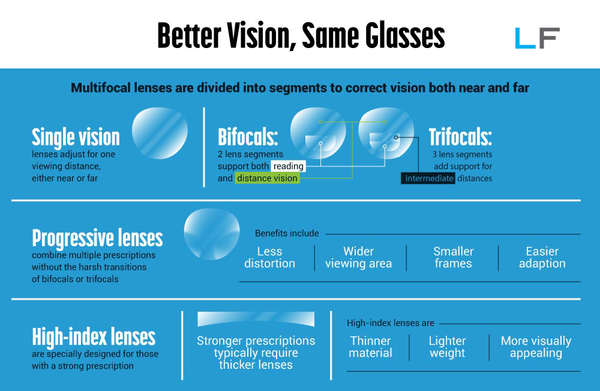
Single-vision lenses have the same prescription throughout the entire lens and are used to correct nearsightedness, farsightedness, or astigmatism. They are the simplest type of lenses and the most affordable.
Bifocal lenses have two prescriptions in one lens, separated by a visible line. The top portion of the lens is for distance vision, while the bottom portion is for near vision. Bifocal lenses are a good choice for people with trouble seeing objects up close or needing help reading.
Trifocal lenses have three prescriptions in one lens, separated by two visible lines. The top portion of the lens is for distance vision, the middle portion is for intermediate vision, and the bottom portion is for near vision. Trifocal lenses are a good choice for people who need help seeing objects at different distances.
Progressive lenses have a gradual transition from distance to near prescriptions, with no visible line. They provide a more natural vision experience than bifocal or trifocal lenses, and they are a good choice for people who need help with both distance and near vision. However, they are more expensive than other types of lenses.
Non-Rx lenses, also known as plano lenses, have no prescription and are used for fashion or as protective eyewear. They can be made in any lens material or design and can include features such as UV protection, polarization, or scratch resistance.
In addition to the lens material and design, there are several lens options to consider when selecting your lenses.
Anti-reflective (AR) coating reduces glare and reflections on the lens surface, improving visual acuity and reducing eye strain. It also makes the lenses appear clearer and less noticeable. AR coating is recommended for people who spend a lot of time in front of a computer or under artificial lighting.
UV protection blocks harmful UV radiation from the sun, reducing the risk of eye damage and vision loss. UV protection is essential for people who spend a lot of time outdoors or who are exposed to UV radiation from artificial sources, such as tanning beds.
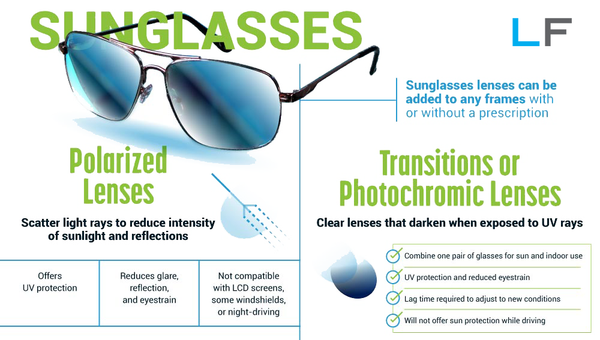
Polarization reduces glare and improves visual clarity by filtering out light that is reflected off flat surfaces, such as water, snow, or pavement. Polarized lenses are recommended for people who spend a lot of time outdoors, especially around water or snow.
Photochromic lenses darken in bright light and lighten in low light, providing automatic protection from glare and UV radiation. Photochromic lenses are a good choice for people who frequently transition between indoor and outdoor environments.
In summary, choosing the right lenses for your eyeglasses is essential for maintaining good vision and preventing eye strain or damage. Understanding your prescription and the different lens options available can help you make an informed decision. At LensFactory.com, we offer a range of lens materials, designs, and options to suit your needs and budget. Whether you need single vision, bifocal, trifocal, progressive, or non-Rx lenses, we can provide you with high-quality, affordable replacement lenses.
]]>In a world filled with captivating sights and precious moments, our eyes are the gateway to experiencing everything that surrounds us.
But in the midst the hustle and bustle of daily life, it's all too easy to overlook the treasure that is healthy eyesight.
As we age, our eyes inevitably become more vulnerable to health issues. From the persistent discomfort of dry eyes to the insidious threat of cataracts and even the potential loss of sight, our eyes demand our unwavering attention and care.
The good news is there are steps you can take to maintain your eye health and reduce your risk of developing these conditions.
We have five methods to share that will help to preserve the well-being of your eyes! By incorporating these practices into your daily routine, you can protect your vision.
Eating a healthy diet is one of the most effective ways to maintain your overall health, including your eye health. Certain nutrients, such as omega-3 fatty acids, lutein, zinc, and vitamins C and E, are particularly beneficial for your eyes.
These nutrients can help protect against age-related macular degeneration, cataracts, and other eye conditions.
To get these nutrients, incorporate into your diet foods like:
If you're having trouble getting enough of these nutrients from your diet alone, consider taking a multivitamin or a supplement specifically designed for eye health.
There are several supplements that have shown potential benefits for eye health. We are not endorsing any supplement, and supplements should not replace a healthy diet or proper medical care.
That said, here are a few supplements that are often recommended for eye health:
Just like your skin, your eyes can be damaged by the sun's UV rays.
This can lead to a range of issues, from temporary discomfort to long-term damage and even blindness. Too much UV exposure can increase chances of cataracts and macular degeneration.
To protect your eyes from UV rays, wear sunglasses that block 99% to 100% of both UVA and UVB rays.
Look for sunglasses with polarized lenses, also. These reduce glare and make it easier to see in bright sunlight.
And don't forget to wear a wide-brimmed hat or visor to provide extra shade for your eyes if you're going to have prolonged exposure to sunlight.
You might think you look goofy wearing the hat. But you'll look a lot more goofy when you're bumping into walls because your eyesight is damaged 😆
It's not uncommon to spend hours each day staring at a computer, phone, or tablet.
If you're an iPhone user, pull your phone out and check the screen time reporting. It's okay, we won't judge too harshly...we all do it!
Unfortunately, all this screen time can have negative impacts on your eye health.
The 20-20-20 rule is a good guideline to follow: every 20 minutes, take a 20-second break and look at something 20 feet away.
This can reduce eye strain and gives your eyes a chance to rest and recover.
Reducing screen time alone may not directly improve eyesight or reverse existing vision problems. But reducing screen time can slow down progression of certain conditions or ease symptoms in the moment.
Regular eye exams are crucial for maintaining your eye health, especially as you get older. During an eye exam, your eye doctor can detect early signs of eye diseases and conditions that may not have symptoms yet.
Depending on your age and medical history, your eye doctor may recommend different frequencies for your eye exams.
In general, adults should have a comprehensive eye exam every two years, or more often if they have a history of eye problems or other health issues.
If you wear prescription glasses, it is important to replace the lenses regularly to maintain your eye health.
Over time, lenses can become scratched, damaged, or accumulate dirt and debris, which can affect your vision and cause eye strain or headaches.
At LensFactory, we offer a convenient and affordable way to order replacement lenses for your glasses.
Our online ordering system makes it easy to choose from a variety of lens types and prescriptions, and we offer fast and reliable shipping to ensure you receive your lenses quickly.
By replacing your glasses lenses regularly, you can ensure that your vision remains clear and comfortable.
Plus, with LensFactory, you can do so without breaking the bank. We offer high-quality lenses at competitive prices, so you can prioritize your eye health without sacrificing your budget.
]]>Eye exams are not only essential for evaluating your vision but also for detecting early signs of eye diseases and other underlying health conditions. Regular exams can help identify conditions like glaucoma, cataracts, macular degeneration, and diabetic retinopathy. Early detection allows for prompt treatment, preserving your vision and overall eye health.
What to Expect at an Eye Exam (700 words)
While an eye exam is essential for evaluating your vision and eye health, purchasing new glasses directly from the optometrist is not your only option. LensFactory offers a convenient solution for replacing your existing lenses without having to buy a completely new pair of glasses.
Wide Selection of Lenses: LensFactory provides a diverse range of high-quality lenses, including single vision, bifocals, trifocals, and progressive lenses. You can choose the lenses that suit your prescription and vision needs.
Regular eye exams are vital for maintaining healthy vision and detecting eye conditions. Understanding what to expect during an eye exam helps you prepare and get the most out of your visit. Additionally, when it comes to vision correction, LensFactory offers a convenient and cost-effective solution for replacing your lenses without the need to purchase new glasses. With a wide selection of lenses, customization options, competitive pricing, and a hassle-free online ordering process, LensFactory ensures that you can easily replace your existing lenses and preserve your favorite frames. Enjoy the convenience of LensFactory for lens replacement while still prioritizing regular visits to your optometrist for comprehensive eye care.
]]>Cataract surgery is typically an outpatient procedure performed under local anesthesia. The surgeon makes a small incision in the cornea, removes the clouded lens using ultrasound energy (phacoemulsification), and inserts a clear IOL in its place. This IOL replaces the natural lens, enabling light to focus properly on the retina and restore clear vision.
While cataract surgery generally provides long-lasting visual improvement, there are instances where lens replacement may be required:
After cataract surgery, proper post-operative care is essential to ensure optimal healing and visual recovery. Patients should follow their surgeon's instructions regarding the use of eye drops, avoiding strenuous activities, and protecting the eyes from irritants. Regular follow-up visits allow the surgeon to monitor healing progress and address any concerns.
In cases where a lens replacement is necessary, the decision is made after careful evaluation by the surgeon. Factors such as the patient's overall eye health, degree of refractive error, and personal preferences are taken into consideration. The surgeon will discuss the available options and guide the patient in choosing the most suitable replacement lens.
The decision to replace glasses lenses after cataract surgery depends on several factors:
To obtain the best visual outcome with glasses lens replacement after cataract surgery, it is essential to consult with an optometrist or ophthalmologist experienced in post-cataract vision correction. These professionals will perform a comprehensive eye examination and determine the most appropriate prescription for your glasses lenses.
When considering glasses lens replacement, it is advisable to:
After undergoing cataract surgery, glasses lens replacement may be necessary to address residual refractive errors or presbyopia. LensFactory emerges as the go-to destination for obtaining top-quality replacement lenses. With their wide selection of lenses, customization options, commitment to quality, and user-friendly online ordering system, LensFactory ensures that you can find the perfect lenses to optimize your vision after cataract surgery. Trust LensFactory to deliver lenses that meet your specific needs and provide the clarity and visual acuity you desire.
]]>Sunglasses are not only a fashion accessory. They're also essential for protecting your eyes from harmful UV rays and reducing glare. After extensive use or accidental damage, the lenses of your favorite sunglasses may become scratched, foggy, or broken.
Aside from the aesthetics being wrecked, worn or damaged lenses also compromise the effectiveness of sunglasses. That's a bummer!
We offer a convenient solution with our wide range of prescription and non-prescription replacement sunglasses lenses. We have different lens materials, such as glass, plastic, polycarbonate, high-index options, and Transitions XTRActive polarized lenses.
Whether you rock out in Aviators, Wayfarers, or just about any other designer frames, LensFactory has you covered with high-quality lens replacement that will give you a fresh look and eye protection.
Naturally, sunglasses lenses can become scratched, foggy, or damaged, affecting their ability to provide optimal UV protection and reduce glare. Accidental breakage or loss of lenses can also leave your sunglasses unwearable.
It's essential to replace damaged or worn-out lenses to restore the functionality and aesthetics of your sunglasses.
With LensFactory, you can simply replace the lenses in your sunglasses, keep those designer frames you love, and enjoy clear vision, UV protection, and reduced glare.
LensFactory offers a variety of lens materials for their replacement sunglass lenses to suit different preferences and needs.
Let's take a closer look at each option.
Glass lenses are known for their superior optical clarity and scratch resistance. They provide excellent visual acuity and are highly resistant to scratches, making them a durable choice for sunglass lenses.
Glass lenses also provide exceptional polarizing properties, which reduce glare and enhance visual comfort, making them ideal for outdoor activities such as driving, fishing, and sports.
Additionally, glass lenses are naturally UV resistant, blocking 100% of harmful UVA and UVB rays, ensuring maximum eye protection.
LensFactory offers glass lenses as a premium option for their non-rx replacement sunglass lenses, providing unmatched optical performance and durability for those seeking the highest quality lenses for their sunglasses.
Plastic lenses are lightweight and inexpensive. But they can be brittle, so they're popular for sunglass lenses for less active people. Plastic lenses are more affordable than glass lenses and an excellent option for casual sunglasses. Plastic lenses are also naturally UV resistant, providing reliable protection against harmful UV rays.
We offer plastic lenses for prescription and non-prescription replacement sunglass lenses, a cost-effective option that doesn't require compromising style and performance.
Polycarbonate lenses are known for their exceptional impact resistance and lightweight design, making them a preferred choice for sports and active wearers.
They are highly durable enough to withstand accidental drops and impacts without shattering. And they provide added eye safety, especially for those who love outdoor activities.
Polycarbonate lenses deliver excellent UV protection and block 100% of UVA and UVB rays, ensuring your eyes are shielded from harmful UV radiation. This makes polycarbonate an ideal choice if you prioritize durability and safety.
We offer polycarbonate lenses for replacement sunglass lenses.
High-index lenses are designed for those with higher prescriptions. These lenses are thinner and lighter than traditional lenses, providing a more comfortable and aesthetically pleasing fit, especially for those with stronger prescriptions.
Aside from the various lens materials, LensFactory also offers replacement sunglasses lenses for different vision needs: single vision, bifocal, trifocal, or progressive lenses. We have options to cater to your specific vision requirements.
Single vision lenses are the most common type and are typically used for correcting nearsightedness, farsightedness, or astigmatism.
We offer single vision replacement sunglass lenses, allowing you to replace the lenses in your sunglasses and enjoy clear vision without needing a prescription. Single vision lenses are perfect for those who only require correction for distance vision or near vision. In other words, those who do not need multifocal lenses.
Bifocal lenses have two distinct zones - the upper part for distance vision and the lower part for near vision. They are commonly used by individuals with presbyopia, which affects near vision.
If you wear bifocal glasses for everyday use, you can also benefit from LensFactory's bifocal replacement sunglass lenses. These lenses provide clear vision for both distance and near vision, allowing you to enjoy outdoor activities without compromising visual clarity.
Trifocal lenses have three distinct zones:
Trifocals are suitable for individuals who require correction for multiple distances, such as for reading, computer work, and distance vision.
LensFactory also offers trifocal replacement sunglass lenses, providing clear vision for all three zones and enabling you to enjoy various outdoor activities without switching between glasses.
Progressive lenses, also known as no-line bifocals, are multifocal lenses that provide a seamless progression of lens powers for distance, intermediate, and near vision without any visible lines on the lens surface.
They are popular among those who require correction for presbyopia but prefer a more natural and aesthetic appearance than traditional bifocal or trifocal lenses.
LensFactory offers progressive replacement sunglass lenses, allowing you to maintain clear vision for all distances while enjoying the benefits of polarized lenses in your sunglasses.
Not everyone requires a prescription for their sunglasses, of course. Non-prescription replacement sunglasses lenses provide a convenient solution for those who need to replace their sunglasses lenses without the need for a prescription.
Non-prescription replacement sunglass lenses are ideal for individuals who have perfect vision or who prefer to use their sunglasses as a fashion accessory. They are also suitable for those who wear contact lenses but still want the benefits of polarized lenses in their sunglasses for glare reduction and UV protection.
There are several benefits to choosing replacement sunglasses lenses vs. going out and dropping hundreds of dollars on new frames. The cost savings are a no-brainer. But that's not all. There's also the convenience of online lens replacement, options to customize your lenses,
Replacement sunglasses lenses are more affordable compared to replacing your entire pair of glasses, especially if you have expensive designer frames that you love.
With online lens replacement services, like LensFactory, you can save as much as 75% compared to retail.
LensFactory makes it easy and convenient to replace your sunglass lenses without the need for a prescription.
Their user-friendly website allows you to select the lens material, lens type (single vision, bifocal, trifocal, or progressive), and any additional options, such as polarized lenses or Transitions XTRActive, all without the need for a prescription.
This saves you time and effort in obtaining a new prescription and allows you to quickly replace your sunglass lenses and get back to enjoying clear vision and UV protection.
Replacement sunglass lenses are versatile and cater to a wide range of vision requirements. Whether you have perfect vision, wear contact lenses, or have multifocal needs, LensFactory has options to suit your requirements.
You can choose from different lens materials, lens types, and additional options, such as polarized lenses, to customize your sunglasses to your specific needs.
Sunglasses are not only about protecting your eyes from harmful UV rays, but they are also a fashion statement. With replacement sunglass lenses from LensFactory, you can update the look of your sunglasses and keep up with the latest styles and trends.
You can choose from a variety of lens colors, coatings, and finishes to personalize your sunglasses and elevate your style.
Replacement sunglasses lenses from LensFactory are designed with polarized lenses that provide superior UV protection and glare reduction.
Polarized lenses block harmful UV rays from the sun, protecting your eyes from potential damage caused by prolonged exposure to UV radiation.
They also reduce glare caused by reflections from surfaces such as water, snow, and roads, providing you with clearer vision and visual comfort.
Sunglasses are essential for outdoor activities such as sports, driving, and leisure activities. Replacement sunglass lenses from LensFactory allow you to enjoy your favorite outdoor activities with clear vision and improved comfort.
Polarized lenses reduce glare and enhance contrast, providing you with better visual clarity and depth perception, which is particularly important for activities such as driving and water sports.
If you wear prescription sunglasses, replacement sunglass lenses can also be a convenient option for replacing damaged or outdated lenses.
LensFactory offers prescription lens replacement services, allowing you to replace the lenses in your prescription sunglasses without having to purchase a whole new pair. You can simply select your prescription details, including lens material, lens type, and additional options, and LensFactory will provide you with replacement lenses that match your prescription.
Replacement sunglass lenses from LensFactory offer a convenient and cost-effective solution for updating your sunglasses and maintaining optimal eye protection.
With a wide range of lens materials, lens types, and additional options available, you can customize your sunglasses to suit your specific vision needs and style preferences. Ordering replacement sunglass lenses from LensFactory is easy and hassle-free, and the lenses are carefully crafted to ensure a precise fit and optimal performance.
Whether you need single vision, bifocal, trifocal, progressive, or non-prescription lenses, LensFactory has options to cater to your vision requirements.
So, why wait?
Upgrade your sunglasses with replacement sunglass lenses from LensFactory and enjoy clear vision, UV protection, and style all in one!
]]>
Bad eyesight can be caused by various factors, such as refractive errors (nearsightedness, farsightedness, astigmatism), age-related conditions (presbyopia), environmental factors such as diet and phone use, and eye diseases (cataracts, glaucoma)
Genetics can indeed play a role in the development of bad eyesight, as certain eye conditions have a hereditary component. Individuals with a family history of conditions like myopia (nearsightedness), hyperopia (farsightedness), astigmatism, or certain eye diseases may have an increased risk of developing these conditions themselves.
While genetics can contribute to bad eyesight, environmental factors and lifestyle choices also play a significant role. Environmental factors such as prolonged near work, excessive screen time, and inadequate lighting can strain the eyes and contribute to the development or progression of refractive errors. Additionally, lifestyle choices such as poor nutrition, smoking, and lack of physical activity can impact overall eye health.
Regular eye exams are crucial for individuals with a genetic predisposition to bad eyesight. Eye exams can detect and monitor inherited eye conditions, allowing for early intervention and appropriate management. Optometrists can prescribe corrective lenses or recommend other vision correction methods to optimize visual acuity and minimize the impact of inherited eye conditions on daily life.
By understanding the interplay between genetics, environmental factors, and lifestyle choices, individuals can make informed decisions to protect and maintain their vision. Proactive measures such as regular eye exams, adopting healthy visual habits, and making lifestyle changes when necessary can help mitigate the impact of genetic predisposition and promote optimal eye health.
Excessive screen time has become a common part of our modern lifestyle, and it can take a toll on our eyes. The blue light emitted by digital devices, such as smartphones, tablets, and computer screens, can contribute to eye strain and discomfort. Prolonged exposure to this blue light has been associated with potential vision problems, including digital eye strain, dryness, blurred vision, and headaches.
To reduce eye strain caused by screens, it is important to implement practical tips and habits. Maintaining an appropriate viewing distance by keeping the screen at arm's length and slightly below eye level can help alleviate strain. Following the 20-20-20 rule is also beneficial—take a break every 20 minutes and focus on an object about 20 feet away for at least 20 seconds. This gives your eyes a chance to rest and readjust.
Adjusting screen settings to reduce brightness and minimize blue light emission can be helpful. Most devices offer options to reduce blue light, such as Night Shift or Night Mode. Alternatively, using blue light filters or wearing specialized glasses with blue light-blocking coatings can provide additional protection.
Incorporating regular eye breaks, practicing good ergonomics, and ensuring proper lighting in the surrounding environment are other effective measures to reduce eye strain. Additionally, maintaining a balanced lifestyle that includes physical activity, proper hydration, and a healthy diet can support overall eye health and reduce the impact of screen-related eye strain.
By implementing these practical tips, individuals can minimize the negative effects of excessive screen time and protect their eyes from the potential vision problems associated with prolonged screen exposure. It is essential to be mindful of our screen habits and prioritize healthy visual practices in our daily routines.
Recognizing the early signs of bad eyesight is crucial for timely intervention and effective management. Some common indicators include frequent headaches, eye fatigue, difficulty reading, and problems with focusing. Blurry vision is another significant symptom that may indicate the presence of refractive errors or other underlying eye conditions.
Understanding the causes of blurry vision can help individuals make informed decisions about seeking professional eye care. Refractive errors such as myopia, hyperopia, and astigmatism can cause blurry vision at different distances. Eye conditions like dry eye syndrome, cataracts, or glaucoma can also contribute to blurred vision.
Seeking professional eye care is essential to determine the root cause of blurry vision and receive appropriate treatment. Optometrists can conduct comprehensive eye exams, diagnose any underlying conditions, and prescribe corrective lenses or recommend other suitable interventions. Regular eye exams also enable early detection of eye diseases, providing an opportunity for timely management and prevention of vision loss.
While professional eye care is vital, individuals can also explore natural methods to support vision improvement. Eye exercises, relaxation techniques, and practicing good visual habits can help strengthen eye muscles and alleviate eye strain. Maintaining a healthy lifestyle through a balanced diet rich in nutrients beneficial to eye health, regular exercise, and adequate hydration can also contribute to overall visual well-being.
By recognizing the early signs of bad eyesight and seeking professional eye care, individuals can address vision issues promptly and prevent further deterioration. Incorporating natural methods for vision improvement as part of a healthy lifestyle can complement professional care and contribute to long-term eye health and clarity of vision.
Maintaining good eyesight relies on various factors, including proper nutrition and vitamin intake. Certain vitamins and minerals play a crucial role in supporting vision health. Vitamin A is essential for the functioning of the retina and low levels can lead to night blindness and dry eyes. Citrus fruits, leafy greens, and carrots are rich sources of vitamin A.
A balanced diet that incorporates these nutrient-rich foods is vital for supporting overall eye health. Including a variety of leafy greens, colorful fruits, fish, nuts, and seeds can provide the necessary vitamins and minerals to promote good eyesight. It is important to note that while a healthy diet can support eye health, it does not replace regular eye exams and professional eye care.
When it comes to restoring eyesight, advancements in medical technology have opened up new possibilities. One such treatment is cataract surgery, which involves removing the clouded lens and replacing it with an artificial lens implant. This procedure can significantly improve vision and restore clarity, allowing individuals to regain their independence and enjoy a better quality of life.
In addition to cataract surgery, the use of advanced technologies has revolutionized vision correction. Innovative procedures like LASIK and PRK reshape the cornea to correct refractive errors such as nearsightedness, farsightedness, and astigmatism. These procedures offer precise and long-lasting results, providing individuals with clearer vision without the need for glasses or contact lenses.
LensFactory plays a significant role in helping individuals upgrade their vision through lens replacement services. This convenient solution allows individuals to replace their lenses while keeping their favorite frames intact. The process is hassle-free, offering customization options to cater to specific prescriptions and lens preferences. Whether it's single vision, bifocal, or progressive lenses, LensFactory ensures the highest quality lenses to meet individual needs.
By preserving their favorite frames, LensFactory enables individuals to maintain their personal style and comfort while benefiting from improved vision. This not only saves them the cost of purchasing new glasses but also allows them to continue wearing frames they love.
LensFactory's lens replacement services are a reliable and cost-effective solution for individuals seeking to upgrade their vision and enhance their visual experience. With convenience, customization, and top-quality lenses, LensFactory makes it easier than ever to restore and improve eyesight without compromising personal style.
As we age, our eyes undergo natural changes that can impact vision. Two common age-related changes are presbyopia and reduced visual acuity. Presbyopia is the gradual loss of the eye's ability to focus on nearby objects, making it difficult to read or perform close-up tasks. Reduced visual acuity refers to a decline in overall sharpness and clarity of vision.
Regular eye exams become increasingly important for seniors to monitor these age-related changes and detect any underlying eye conditions. Eye exams allow optometrists to assess visual acuity, screen for eye diseases like glaucoma and cataracts, and prescribe appropriate vision correction methods. Early detection of any issues can lead to timely interventions and improved quality of life.
One misconception surrounding age-related vision changes is that they are unavoidable and untreatable. While it's true that these changes are a natural part of the aging process, there are effective ways to manage them. Prescription eyeglasses or contact lenses can compensate for presbyopia, enabling seniors to read and perform close-up tasks with ease. For reduced visual acuity, corrective lenses or refractive surgeries like LASIK may be recommended to enhance distance vision.
Proactive eye care is vital for seniors to maintain good vision health. It involves not only regular eye exams but also adopting healthy habits and lifestyle choices. Protecting the eyes from harmful UV rays by wearing sunglasses and using adequate eye protection in certain environments is crucial. Eating a nutritious diet rich in vitamins and antioxidants can also support eye health. Additionally, managing systemic conditions like diabetes and hypertension, which can affect vision, is important in preserving eye function.
By emphasizing the benefits of proactive eye care, such as maintaining independence, preventing accidents, and enjoying a higher quality of life, seniors can be encouraged to prioritize their vision health. Age-related changes in vision shouldn't be seen as an inevitable decline, but rather as a manageable aspect of aging that can be addressed with the help of regular eye exams, appropriate vision correction methods, and healthy lifestyle choices.
Understanding the causes and remedies for bad eyesight is essential for maintaining optimal vision health. While bad eyesight can result from various causes such as refractive errors, genetics, age-related changes, and eye diseases, there are solutions available to address these issues.
Corrective measures like glasses, contact lenses, refractive surgery, and lens replacement services offered by LensFactory can effectively improve vision. LensFactory provides a convenient solution for individuals looking to replace their lenses while retaining their preferred frames.
Regular eye exams play a crucial role in detecting early signs of bad eyesight and managing existing conditions. It is important to address blurry vision promptly by seeking professional eye care to determine the underlying cause and appropriate treatment options.
While genetics can contribute to bad eyesight, lifestyle factors, such as excessive screen time, can also impact vision. Practicing healthy screen habits, taking breaks, and protecting against blue light exposure can help mitigate potential eye strain and discomfort.
Maintaining a balanced diet rich in essential vitamins and minerals is beneficial for overall eye health. Certain nutrients, including vitamins A, C, E, zinc, and omega-3 fatty acids, are known to support good vision. Incorporating foods like leafy greens, carrots, citrus fruits, fish, and nuts into your diet can promote healthy eyesight.
It is important to note that while some vision conditions may not be completely reversible, advancements in medical technology have made it possible to restore eyesight through treatments like cataract surgery and innovative vision correction procedures.
LensFactory offers lens replacement services as a convenient and cost-effective alternative to purchasing new glasses. With a wide range of high-quality lenses and customization options, LensFactory allows individuals to upgrade their vision while keeping their preferred frames.
In conclusion, bad eyesight can be caused by various factors, but there are remedies available to address and improve vision. Regular eye exams, proper vision correction methods, healthy screen habits, a nutritious diet, and lens replacement services from LensFactory can help individuals maintain optimal vision health and enhance their overall quality of life.
]]>An optician is a trained professional who specializes in the fitting, customization, and dispensing of eyeglasses and contact lenses. They work closely with optometrists and ophthalmologists to ensure that patients receive accurate prescriptions and obtain the most suitable eyewear solutions. Key points to discuss include:
An optometrist is a primary eye care provider who examines, diagnoses, and manages various eye conditions. They are licensed to perform comprehensive eye exams, prescribe corrective lenses, and diagnose and treat common eye diseases. Key points to discuss include:
An ophthalmologist is a medical doctor who specializes in eye and vision care, including the diagnosis, treatment, and management of eye diseases and disorders. They have completed medical school, residency training, and often pursue additional fellowship training. Key points to discuss include:
While opticians, optometrists, and ophthalmologists focus on different aspects of eye care, LensFactory offers a convenient solution for lens replacement that aligns with their expertise. Discuss the following points:
Understanding the distinctions between opticians, optometrists, and ophthalmologists is crucial for navigating the realm of eye care. Opticians specialize in lens fitting and customization, while optometrists provide primary eye care and prescribe corrective lenses. Ophthalmologists are medical doctors who diagnose and treat complex eye conditions and perform surgical interventions. LensFactory offers a convenient solution for lens replacement, complementing the expertise of these eye care professionals. With a wide selection of lenses, customization options, and an easy online ordering process, LensFactory enables customers to replace their lenses while preserving their favorite frames. By emphasizing quality, convenience, and cost-effectiveness, LensFactory provides a reliable and sustainable solution for maintaining optimal vision and enhancing overall eye care.
]]>Opticians are trained professionals specializing in the fitting, customization, and dispensing of eyeglasses and contact lenses. They work closely with optometrists and ophthalmologists to ensure that individuals receive accurate prescriptions and obtain the most suitable eyewear for their visual needs. Some key responsibilities of opticians include:
Interpreting Prescriptions: Opticians carefully analyze the prescriptions provided by optometrists or ophthalmologists to determine the specific lens powers, lens types, and other necessary specifications required for optimal vision correction
Assisting with Frame Selection: Opticians guide patients in selecting frames that not only complement their personal style but also properly accommodate their prescription lenses. They consider factors such as facial features, lifestyle, and visual requirements when recommending frame options.
Lens Fitting and Customization: Opticians use their expertise to precisely fit lenses into the chosen frames, ensuring proper alignment and visual clarity. They may customize lenses by taking additional measurements and considering individual preferences for factors like lens materials, coatings, and specialty features.
Contact Lens Services: Opticians provide comprehensive services related to contact lenses, including fitting, instruction on lens insertion and removal, and educating patients on proper care and maintenance.
Adjustments and Repairs: Opticians are skilled in making adjustments to eyewear to ensure a comfortable fit. They also offer repair services for damaged or broken frames, providing cost-effective solutions to extend the life of eyewear.
LensFactory not only offers an extensive range of high-quality lenses but also provides convenient lens replacement services that align with the expertise of opticians. Here's how LensFactory makes lens replacement a seamless process:
Wide Selection of Lenses: LensFactory offers a diverse selection of lenses, including single vision, bifocals, trifocals, and progressive lenses. These lenses are crafted using advanced manufacturing techniques and premium materials to ensure optimal visual acuity and durability.
Preserving Favorite Frames: LensFactory understands the attachment individuals may have to their favorite frames. Rather than purchasing new glasses, LensFactory enables customers to replace their lenses, allowing them to keep their preferred frames while enjoying updated vision correction.
Customization and Precision: Just like an optician, LensFactory recognizes the importance of customized vision solutions. Their lenses are made to order, ensuring precise customization based on individual prescriptions and preferences. This level of customization guarantees optimal visual performance and personalized comfort.
Convenient Online Ordering: LensFactory offers a user-friendly online platform that simplifies the lens replacement process. Customers can easily input their prescription information, select lens options, and place their order from the comfort of their own homes. The lenses are then shipped directly to the customer's doorstep.
Quality Assurance: LensFactory is committed to delivering lenses of the highest quality. They source their lenses from reputable manufacturers, ensuring excellent craftsmanship and adherence to strict quality standards. Customers can trust that their replacement lenses from LensFactory will provide clear vision and long-lasting performance.
Cost-Effective Solution: Lens replacement at LensFactory offers a cost-effective alternative to purchasing new glasses. By keeping existing frames and replacing the lenses, customers can save money while
Opticians play a crucial role in providing expert vision care and personalized eyewear solutions. Their responsibilities encompass interpreting prescriptions, assisting with frame selection, lens fitting and customization, and providing contact lens services. In line with the expertise of opticians, LensFactory offers convenient and high-quality lens replacement services. With a wide selection of lenses, customization options, and a user-friendly online ordering process, LensFactory ensures that customers can replace their lenses while preserving their favorite frames. The company's commitment to quality and cost-effective solutions makes LensFactory an excellent choice for individuals seeking reliable lens replacement services. Trust LensFactory to deliver top-notch lenses and personalized eyewear solutions that meet your visual needs with convenience and expertise.
]]>LensFactory is a leading online retailer of prescription lenses for eyeglasses and sunglasses. We offer a wide variety of lens materials, coatings, and features, all at a fraction of the cost of traditional optical stores.
There are many reasons to choose LensFactory for your lens replacement needs. Here are just a few:
LensFactory offers a wide variety of lens materials, coatings, and features to choose from. Here are just a few of the types of lenses that are available:
If you're looking for a new pair of prescription lenses, LensFactory is the best place to shop. We offer a wide variety of lenses, coatings, and features at a fraction of the cost of traditional optical stores. Plus, they have a team of experienced opticians who are available to answer any questions you may have.
I hope this article has helped you learn more about LensFactory and why we are the best lens replacement service for your needs.
]]>After years of research and development in our optical labs, we have finally accomplished the so-called "impossible."
We invented PuppyPeepers - glasses for dogs!
Yes, you read that right.
We know how much you love your furry friends, so we're making sure they can see the world in all its glory.
These new glasses allow your pup to experience the beauty of nature.
The excitement of playtime.
And the joy of chasing squirrels.
All with paw-fect, crystal clear vision.
Our dog glasses can suit every pup's personality. Whether your canine is sporty, chic, or classic, we have the perfect pair.


Plus, the lenses are scratch-resistant and shatterproof. No worrying about your dog's glasses getting damaged.
Last but not least, our glasses are designed to be adjustable for a comfortable fit on any dog's snout.
Because the ol' glasses-sliding-down-the-nose thing is annoying, regardless of species.
Don't just take our word for it...
Read what a few of our early testers had to say.
And the best part?
Our glasses for dogs are available at an affordable price point, so you won't break the bank spoiling your furry friend.
ONE LAST THING!
April Fools! We love playing pranks!
Please accept our sincerest apologies 😅

Whether you love the outdoors or prefer indoors activities, there are distinct types of lenses that will improve your experience.
A good mechanic will tell you the job is much easier with the right kind of tool.
It's much the same with glasses. If you pick the right lenses with the right enhancements, the activity you are doing will be easier and more satisfying.
There are polarized lenses that block glare.
There are photochromic lenses that darken with increased sunlight.
Tints that improve contrast or improve color variation in landscapes.
Blu-Blockers that, you guessed it, block blue light.
And anti-glare coatings that allow more light to enter, which helps block glare.
The correct lens upgrades to plastic, polycarbonate, or glass lenses add to the wearers positive experience.
While you're fishing, does the glare from the water's surface make it difficult to see below the surface? Does it make your eyes hurt?
Polycarbonate and Trivex are both recommended lenses because they are lightweight and impact-resistant.
Polycarbonate is thinner and lighter, but less resistant to scratches.
That said, many anglers prefer glass lenses due to their scratch resistance.
Glass is also the clearest material. It is heavier, but to many wearers, the scratch resistance wins out and they choose glass if the prescription is low.
There are different treatments and lenses to consider depending on whether you fish in shallow water or deep water:
Off-shore fishing is when you are fishing at least thirty meters deep, and fishing is done in direct sunlight. The glare and sunlight bouncing off the water is intense, which makes it hard to track the fish.
An excellent choice for lenses is a gray polarized lens with a blue mirror. These enhancements will not only allow to see the fish under the water, but also block the glare that hurts your eyes.
Shallow water fishing is for water less than 30 meters deep. The focus in this situation is to optimize contrast, so of course polarized lenses make sense. All fishing lenses should be a polarized lens.
The polarized lenses should have a copper base color and a green mirror. This will improve contrast in the darker water.
Besides your prescription glasses giving you the ability to see better, a shooter or hunter in the outdoors would appreciate being able to see brighter and with optimal contrast.
If you shoot target practice or skeet, yellow or rose lenses will make targets brighter with more contrast.
If you are an avid hunter, then polarized lenses are an option as well as Photochromic lenses and a non-nlare coating will improve contrast and reduce glare.
Is it hard to see your ball in certain light conditions? Or is it hard to see your ball in the sky to know where it is going?
The right pair of glasses can improve the contrast between your golf ball and the sky, as well as other backgrounds on the golf course.
A contrast enhancement (e.g. rose tint) and a mirror coating are necessary, because these features enhance depth perception and clarity.
Polarized lenses on the other hand are not a good option for golfers. Polarized lenses play havoc with depth perception, which is not so great on a golf course.

Besides goggles when you are active, your dress glasses can help you navigate a snowy holiday. Glare from sunlight reflecting off the snow can be blinding. You can choose lenses that will block this glare.
Polarized lenses are an excellent choice, or look for transitions lenses, which change with the environment and conditions. Pair that with a non-glare coating and you'll never wince again!
Cyclists should select lenses that are scratch resistant and lightweight to ensure durability. Avoid polarized lenses, because polarization throws off depth perception.
Instead focus on contrast – enhancing colors. Consider a rose or copper tinted lens and, of course, a non-glare coating.
Polarized lenses are what you want to have when you are on the water, period!
These lenses protect your eyes from painful glare and allow you to see through the surface glare of the water. That means you can see any obstacles underneath the surface of the water.
Polarized lenses come in assorted colors. A rose or green tint is a good choice.
If running is your jam, try a polycarbonate lens. They are lightweight and impact resistant. You can choose a lens color that will improve your eye comfort, improve contrast relative on your terrain, and allow you to see all the bright colors.
The goal is to choose a lens color that will offer the best contrast.
High contrast lenses boost depth and color perception, and they will help you read the terrain. The best tint to choose is a rose-copper.
Stay away from gray tints, because they will tend to block color variations and make everything look gray.
If you wear prescription lenses and spend hours on a computer each day, get glasses with blu-blocker, along with an easy to clean non-glare coating on your lenses.
Digital screens have a negative effect on the health of our eyes, often making them hurt after being on the computer for a couple of hours.
Blue light, which comes from device screens, can suppress melatonin production, which causes sleep disruption. Lenses that block blue light can give you a more consistent sleep schedule.
A non-glare coating on the lenses will generally reduce the glare from your computer or phone screen.
]]>That number is even higher when you include children under 18.
Still, only 12-15% of consumers choose to purchase their eyewear online.
Shopping online, it can be difficult to know what frames will fit and look great on you.
Will the company get your prescription correct?
What if something gets lost in the mail and you're without glasses?
Eyewear is a big investment and buying online can come with uncertainty. Below are lots of questions answered to hopefully make you feel more confident ordering prescription lenses online.
Often, the frames have simply outlived the lenses. If you're looking for replacement lenses, these are common reasons you may go the online lens replacement route:
In general, you can replace lenses in any frame.
By upgrading your lenses, you’re upgrading your vision and hopefully seeing better than before, without changing your look.
We have a few exceptions in our FAQs page, and you're always welcome to contact us with questions before ordering.
Absolutely, you can!
High Index Lenses are usually the way to go.
With our US-based lab, we can handle the strongest of prescriptions and help guide you to the right choice, so you don't have that “glass bottle” look in your glasses.
Offering just about any prescription need from plano (no prescription) to prisms, we can take care of it.
You can!
In fact, we have a wide selection of lenses available by vision need and prescription specifics.


Did you know that tinted or colored lenses aren't just for looks?
Certain tints can benefit your daily life, depending on your job or the hobbies you take part in.
Some people with dyslexia even report fewer problems with tinted lenses.
Yes, you can replace your polarized or Transitions lenses. Even if you don’t have polarized or transitions lenses today, you can replace your lenses with them.
Polarized lenses scatter light rays to reduce the intensity of sunlight and reflections. Additional benefits include UV protection, reduces glare, reduced reflection, and less eyestrain.
Transitions lenses (photochromic lenses) combine one pair of glasses for indoor and outdoor use. They are clear lenses that darken when exposed to UV rays.
Transitions lenses are also available as polarized Transitions lenses.

From the time we get your frames, most lens replacements are completed and back to you within 3-5 business days.
The simpler your selections and prescription are, the quicker they go out.
Generally there are 1-3 days on the front and back of the replacement process for shipping, which can make the total processing time as little as 5 days.
Plastic lenses without any coatings are very quick. They can usually be in and out of our labs within 1-2 days.
On the other hand, glass lenses with anti-reflective coating can take up to a few weeks.
If you’re unsure about how long it will take, just ask us!
At the end of the day, deciding to choose replacement lenses over purchasing a new set of frames and lenses comes down to a question of need, willingness to try a new method, financial situation, and other factors.
Are your frames broken? Of course, replacement lenses cannot fix that.
However, if you love your frames, for the most part you can keep them and just replace the lenses.
We’ve shown that no matter your vision needs, your frame type, your material or coatings, LensFactory has you covered.
]]>Generally, that means you’re focusing on the brand, color, and shape of the frame.
While having great frames is important, it's the lenses that protect your eyes and correct vision problems.
Vision problems range from person to person, but the main refractive problems are nearsightedness, farsightedness, astigmatism, and presbyopia.
These problems can often be minimized or resolved with the proper lens upgrades.
A few common lens upgrades we offer at LensFactory are anti-reflective coating, anti-fog coating, photochromic lenses, blue light lenses, and tinted lenses.
These lens upgrades offer all sorts of benefits, like reduced glare and reflections, protection from UV rays and blue light, minimizing foggy lenses, and let's be honest - some of them look just plain awesome (especially on you!).
All of these upgrades point back to the most important thing: keeping your eyes healthy and your vision clear.
The most common lens feature prescribed by your doctor will be anti-reflective coating, often abbreviated AR.
Anti-reflective coating blocks reflections and glare from overhead lights or camera flashes, so that other people can see your eyes. This lens upgrade also assists with nighttime driving because it blocks headlight glare from oncoming traffic and streetlights.
Anti-reflective coating, sometimes called anti-glare coating, is a lens coating designed to decrease or eliminate the amount of light that is reflected from your lenses.
The coating can be applied to the back, front, or both sides of your lenses to help reduce the amount of glare or mirror effect you get when looking into your lenses.
About 4% of light will be refracted at each surface of an uncoated lens. When anti-reflective coating is applied, it reduces the refraction to less than .1%.
So, instead of only 91% of the light that enters your lenses reaching your retina, 99.9% reaches your retina.
In plain language, you will definitely see better with anti-reflective coating on your lenses.
Anti-reflective coating is a layered combination of metals or oxides. These metals and oxides are put into a vacuum deposition coating machine in a powder form.
As the materials and lenses rise in temperature, the oxide powder coats the lenses in a specific order, depending on the type of coating being applied.
If you’re interested in how glasses are made, check out this cool video of our lab, one of the largest in the industry.
Fun fact: our lab manufactures approximately 6,000+ pairs of eyeglasses per day. Safe to say we know what we're doing!
Anti-reflective coatings will help you see better, without a doubt.
Upgrading will also enhance the clarity of your lenses and virtually eliminate the reflections that you and others would otherwise see in your lenses.
Anti-reflection coating reduces eye strain by allowing virtually 100% of available light to reach your eyes.
Yes! Like just about anything, there are name brands of AR coating available.
Here at LensFactory, we offer our house brand of anti-reflective coating, which was designed and formulated in-house to be a great alternative at less than half the cost of a name brand.
Adding any feature to your lenses will increase the cost, that's a given. After all, there is more work and material going into your custom lenses.
Here at LensFacotry, we offer complete lens replacement for less than half the cost of purchasing through a retail store.
So, an upgrade for anti-reflective coating, for something you use daily and that helps you have clearer vision, is worth a nominal fee in our view.
To us and to most of our customers, anti-reflecting coating isn't too expensive. Anti-reflective is the most popular lens upgrade at LensFactory, with roughly 65% of our orders containing it.
Tired of having your glasses fog up every time you get out of your cold car on a hot summer day?
How about when you’re wearing a mask and your glasses must be cleaned after a few minutes after putting them on?
Our proprietary anti-fog treatment will keep your glasses free of fog!
We recommend anti-fog coating for medical professionals and other people required to wear a mask all day long.
Anti-fog coating is a treatment applied to the back of the lens, and you do not polish the back of the lens when cleaning them.
Photochromic lenses offer an all-in-one prescription eyeglasses and sunglasses solution.
These special lenses are manufactured with a mix of chemicals that react to ultraviolet (UV) rays.
The UV rays cause the lenses to darken into sunglasses when outside and exposed to sunshine. When the UV light is removed the lenses return to regular indoor eyeglasses.
Photochromic lenses do not respond to visible light - only to UV light. So, if you are outdoors or in your car and not exposed to UV light, they will not darken.
Most notably, photochromic lenses contain blue light filter, which helps protect your eyes from the glare from computer screens.
Photochromic lenses have different degrees of darkness when exposed to sunlight.
We offer two types of photochromic lens upgrade:
1) Our house brand, for light sensitive people who just want to shade their eyes in sunlight.
2) Transition© brand, which darkens to be more like sunglasses.
Both of these options are available when you're viewing lenses here on our website.
Even though photochromic lenses cost more than clear lenses, they can be quite cost effective.
With photochromic lenses, you end up not having to buy two pairs of glasses: prescription sunglasses and normal glasses. You get the best of both, rolled into one simple solution.
That extra convenience is worth the cost!
Like we mentioned, our in-house brand works great for people who want to shade their eyes in sunlight, but don’t want a really dark lens.
Conversely, we also offer the Transition© XTRActive lenses. These provide a much darker lens in sunlight and are intended to act as sunglasses.
They filter out a good deal of the harmful UV rays emitted from the sun, leading to healthier and happier eyes. And as an added benefit, these also have blue filter built-in to protect your eyes from the computer and other LED screens.
Transitional lenses come in a myriad of styles, shades, and tints that should be suitable for anyone’s taste and fashion.
We offer three iconic lens colors – gray, brown and graphite green (G15).
If you are looking for better contrast to increase visual acuity for things like golfing and fishing, then photochromic brown is the color for you.
And if you are looking for the absolute darkest transition lens possible, you should veer towards Transition© Xtractive in gray.
The traditional photochromic lenses we sell are designed to change color when exposed to UV light.
The windshield in your car has UV protection, so very little sunlight will reach the lens. So, our main options described above probably won't change much in your car.
That said, there are brands offered at a much higher price point that are particularly designed to change in your car. We're glad to help point you in the right direction. Please reach out to support@lensfactory.com for more information.
Photochromic lenses are affected by colder weather, meaning they take a bit longer to react to UV rays in the winter time.
You may find your lens are slower to react the colder it gets.
>> Want to know more about photochromic lenses? Check this out.
Sunlight is made of red. orange, yellow, green, blue, indigo, and violet light. When all these colors are combined, they come together and become the white light that we see. Different colors of light impact the eyes in different ways.
Parts of the light spectrum of wavelengths are UV (ultraviolet) light and blue light.
UV light spans from 10nm to 400nm and has been found to cause aging to our skin when exposed for long periods of time.
A slightly longer light wavelength is called blue light, which spans from 450 to 490 nm. This is believed to cause different, yet similar damage to the eye as UV rays.
Blue light is good for you during daylight hours, because it boosts your attention and reaction times. Unfortunately, it has the opposite affect at night when you want to try to sleep and relax.
With all the computers, cell phones, tablets and televisions increasing our exposure to blue light in the evenings, what you are viewing can create problems for the body’s circadian rhythm (biological clock).
This can have a negative impact on sleep patterns and rest. Research shows not sleeping well or getting enough sleep can contribute to cancer, diabetes, heart disease and obesity.
It's important to note that blue light penetrates all the way to the retina of the eye. Research shows that too much exposure to blue light, especially from LED lights, can damage light-sensitive cells in the retina.
This causes changes that resemble those of macular degeneration, which can lead to permanent vision loss. This is a serious problem with LED lights.
As addicting as our screen time can be these days, there's only one great solution to protecting yourself from the risks of blue light: reduce the time you spend looking at bright screens 2-3 hours before bed.
Also, if you work a night shift or use a lot of electronic devices at night, consider wearing blue-blocking glasses or installing an app that filters the blue/green wavelength at night.
Wearing lenses that block blue light will allow other colors of light through, but specifically block blue light.
You can also reduce eye fatigue by taking frequent breaks while on your computer, smartphone, and iPad to allow your eyes to rest.
Lens tints serve a variety of important purposes. As we just pointed out, a well-tinted lens protects your eyes against UV radiation.
Tinted lenses can also give you a high-contrast vision experience even in bright or diffused light.
Sunlight tends to distort contrast and daylight hours have a high percentage of blue scattered light that overpowers all other colors. This leads to a low-contrast vision.
Tinted lenses can filter the blue light radiation down to the optimum level, meaning objects appear with high contrast, and colors and details appear natural.
Tints filter light in different ways, and some tints do a better job at blocking light than others. Some tints can actually enhance colors, while others distort them.
Tints have the ability to enhance vision in certain situations. Although you may admire a certain tint color, it may not be the best one for your lifestyle.
The color of the tint used on your lenses isn't simply a matter of style. Certain lifestyles and types of glasses, such as sport prescription glasses, call for particular upgrades and tints.
Tinting blocks visible light while enhancing certain colors and can improve perceptions of contrast and depth.
The most important question to ask when choosing a lens tint for both sports and casual wear are: when, where, and how are you going to use the eyewear?

At LensFactory, we offer a variety of tint colors in a variety of shades.
Tint responds differently to material and coatings. Plastic will take a tint darker than a polycarbonate material, for example.
Most prescription tinted lenses are specified both by their color and a number that indicates the approximate luminous transmittance of the lens.
Light tints, #1 tints, have transmittance values of about 75% to 85% and are used as fashion tints.
Medium, or #2 tints, have transmittances of about 50%.
Dark tints, #3 tints, are commonly prescribed as sunglasses and have transmittances of approximately 20%.
We also offer a G-15 tint. This is a green tint that was developed by the RayBan company as their signature tint.
Slight blue tints on your prescription lenses can reduce glare from monitors and screens, making them ideal for office workers and people who use screens a lot.
Brighter tints, like yellows and light browns are very cool. Not only do they look great, but they also provide UV protection and superior clarity. These tints can also be very effective at filtering out blue light from electronic devices.
Rose tinted sunglasses, or pink tint, aren’t just a nostalgic way to see the world. They help to reduce blue light, which improves contrast by offering maximum glare and light protection. The high contrast makes them very soothing to the eyes and allows you to see details better, as well as visual depth. This makes rose tints ideal for lazy summer driving.
Dark tints, like green or grey tinted sunglasses, are ideal for when you’re out and about in the summer sun. Dark tints mute brightness, but maintain clarity and strong contrasts. They are dark enough to provide protection from glare but are still light enough to ensure that your vision is not impaired.
Tinted lenses that are too dark may pose a risk for healthy individuals when worn regularly indoors. Your eyes will begin to adapt to the darker view, which makes light exposure in the future feel brighter and sometimes painful.
By doing this over a long period of time, your eyes can become more sensitive to light.
Yellow tints are said to be helpful for moderate to low-level lighting conditions. Surroundings may look brighter. Their contrast-enhancing property makes yellow glasses great for night driving or sports. That said, there may be some color distortion.
Brown lenses are sometimes recommended for people with near-sightedness, or myopia. They may bring comfort to your eyes in sunny conditions or help you better see contrast.
For those with hyperopia (far-sightedness), a gray tint may be beneficial. Gray lenses may also help your eyes deal with fatigue.
Gray lenses also make good all-purpose sunglasses. However, if you are wearing base lenses that don’t block UV light, you will find that the gray tint will allow the pupils to open more, letting more UV light shine on the retina.
Said to enhance color perception, blue or purple lenses might be worn indoors or outdoors. They offer some protection from highly reflective surfaces, like water, glass, or snow. Blue lenses are said to be beneficial in foggy weather as well.
If you’re going out to play golf or tennis in the sunshine, green lenses may help reduce eye strain by filtering the blue and UV rays.
Rose-colored or pink tinted glasses can improve visibility for driving, depth perception and detail. Some precision-tinted migraine glasses have a rosy color to them.
But not just any rosy coating will do — migraine glasses are specifically designed to filter certain wavelengths of light (e.g. light from fluorescent fixtures) that often trigger migraines.
Now you know more about lens upgrades than you ever hoped. If we can help you make a decision about a certain upgrade, or with your lens replacement in general, email us at support@lensfactory.com.
You can learn more about lens replacement with our FAQs.
And of course, we'd love to help you see better! We offer 100% online lens replacement at a fraction of the cost of brick & mortar -- keep your frames, love your lenses.
]]>You find yourself with an outdated vision prescription and want to renew it.
But then it’s the whole “look up your doctor, schedule an appointment, find time away from work and life” thing that gets in the way.
Thanks to our partnership with Visibly, you can say goodbye to that experience.
Visibly's online vision test is the first eye care telehealth technology that connects consumers with licensed eye care professionals.
This new tech allows for vision tests without the need for in-person appointments.
All you need is your computer, a smartphone, and about 6 feet of space behind you for checking your distance vision.
Note: the online exam is valid only for prescription renewals. The technology hasn’t yet advanced to provide an initial vision test – but we’re getting there!
With our online vision test, you can renew your vision prescription in 10 minutes or less from the comfort of your own home.
You'll receive an updated vision prescription from a licensed doctor in less than 24 hours directly to your email.
Basically, we’ve taken the traditional phoropter (the big machine your eye doctor uses to check your eyes) and digitized it.
The phoropter is one of the most basic tools used by your doctor to measure the refractive errors of your vision and determine your prescription needs.
Virtual visual assessments can make a huge difference in the quality of life for those who wear glasses and contacts.
Particularly when they’re unable to make it into an exam room.
Just like online lens replacement, checking your vision online screams convenience, savings, and accessibility.
Online vision exam technology simplifies the vision prescription renewal process for optometrists, ophthalmologists, and patients alike.
In just a few steps, you’re off to renewing your prescription the easy way.
While there is a $25 cost to access our online eye exam, that's a deal compared to what it may cost you to normally see an eye doctor.
Plus, you save tons of time by not having to schedule an appointment and go to your office visit.
Our virtual eye exam takes ten minutes or less. In less than 24 hours, you'll be emailed an updated vision prescription from a licensed doctor.
Lastly, taking an at-home eye exam is hassle-free and contact-free. The ability to take the exam virtually means even people in some areas where eye care professionals may be more difficult gain access to easily renew their prescriptions.
Online healthcare innovations, including online vision tests, are not only helpful and convenient for patients.
They can also prevent our healthcare system from becoming overburdened.
Our online exam takes no more than ten minutes to complete.
And of course, patients who may otherwise be unable to make an in-person appointment can easily mark a vision test off their to-do lists.
The convenience and accessibility of at-home eye exams greatly reduces prescription lapses. Meaning, generally, long-term outcomes in eye healthcare improve and more individuals are safe.
Keeping your vision prescription up-to-date is a key factor in reducing eye strain. Especially in a world where many of us spend hours each day focusing our vision on screens.
Whether you wear contact lenses or glasses, it’s important to renew your vision prescription on time every year, so you can keep seeing clearly.
Vision health is extremely important, and an updated prescription will prevent eye strain and screen fatigue.
Dr. Christopher O’Brien, an Ophthalmologist within Visibly’s Optimized Eye Care doctor’s network, recommends having your eyes checked annually, even if you are not noticing any changes in your sight.
“Maintaining a high level of eye health not only protects your eyes, but also your body as a whole."
>> Experiencing eye strain? Reduce it with these tips from Visibly.
Dr. Karen Dorman, OD also stresses the importance of keeping your vision prescription up-to-date in order to maintain your eye health and performance.
It is important to renew your vision prescription, as recommended by your eye doctor, so that you can continue seeing properly.
When done correctly, an at-home eye exam can accurately measure your vision and provide a prescription for renewing your glasses or contact lenses.
Remember, at-home eye exams are only valid for renewing a prescription, not for an initial vision assessment.
At-home eye exams can be helpful in many situations. But, no, they don’t replace the need for your eye care professional.
Taking a vision test at home won’t check the health of your eyes for symptoms of cataracts, glaucoma or macular degeneration, as examples.
If you’re having trouble seeing with your current prescription, you should see an eye doctor in-person and then consider if online renewals are practical.
Online eye exams are generally great for people who:
Online eye exams, unfortunately, are not free of charge. The nominal fee to renew your prescription online here at LensFactory is $25. That's a bargain considering you'll get a licensed doctor to review your prescription online!
We're also happy to share that we do not mark up the service.
Once you’ve taken the test, you'll only pay if we’re able to renew your prescription.
If your RX seems to have changed since your last visit to your doctor, you won’t be charged.
We will let you know that it may be time for an in-person visit to the optical shop.
Just remember – you don’t have to buy new glasses to get a new prescription. Simply come back to LensFactory with your updated prescription and we will replace your lenses -- you keep the frames.
Generally, health insurance will not cover this expense. However, we will provide you a receipt at the end of your service.
You can submit the receipt to them to verify eligibility. Check your individual plan to see what’s covered for you.
As of this post, only 37 states were allowing the use of online vision testing technology, but this number is growing.
Online vision testing services for prescription renewal are allowed in AK, CA, CO, CT, FL, HI, IA, IL, KS, KY, MA, ME, MN, MO, MS, MT, NC, ND, NE, NH, NV, NY, OH, OK, OR, PA, RI, SD, TN, TX, UT, VA, VT, WA, WI and WY.
Some states are trying to ban this service from being accessible to consumers. Optometrists and optometry manufacturers have lobbied Congress in a claim to protect their market share.
We believe whatever the solution, it should be easy for customers.
While the test isn’t a fit for everyone, it’s a start to disrupting an industry that has lacked innovation for decades.
And we're good to stand behind innovation at all turns.
]]>That is why on Veteran's Day LensFactory salutes both the FS9 and the MS9 along with all of those that were forced to wear a pair during basic training.
LensFactory is a Service Disabled Veteran Owned Small Business (SDVOSB). We support our veterans and honor the all of the sacrifices made at home and abroad by the families and loved ones of our service members.
Birth Control Goggles refers to the ability for the person wearing them to procreate because of the glasses severe lack of style.
BCG stands for Birth Control Goggles. The spectacles' thick frame and large lenses are said to make the wearer so unattractive that chances of connecting with a partner become vanishingly small.
LensFactory can! Give us a call and we can help you through the process if you're one of many US Veterans who have stood by the traditional BCGs and want to update your prescription!
LensFactory re-lenses your existing eyewear allowing you to continue using that frame you love so much!
One of the most common questions we are asked is, why are your prices so much less than my doctor’s prices? The easy answer is, we are a business that is a branch of an optical lab that makes lenses. That’s right! We are a lab located in Louisville KY that has been in business for 30 plus years.
LensFactory is one of several e-commerce stores that is owned and operated by the lab. This allows us to keep our prices low and pass the savings on to our customers.
The second most common question we are asked is, When I am at the eye doctor, after my exam they have me sit in front of someone and they are measuring things, how do you know what measurements to use if I order online?
That someone is known as an optician. An optician is someone who specializes in fitting glasses and making lens. We have over 100 opticians employed here at our lab and can call on them at any time for their expertise and advice. An optician can provide all the measurements we need to re-lens your frame.
If you are ordering online there's one measurement is critical to making your lenses, your pupil distance. It is the distance between your two pupils measured in millimeters and requires a precise measurement.
This number gives the lab what is known as the optical center of the lens. The optical center is the best and clearest vision point on your lens, and you need your pupils to line up directly with that focal point on the lens. Once you are an adult this number will not change, so once you know your pupil distance, record it in your medical records for your future use.
If your pupil distance is not correct it will create eye strain and headaches and make wearing your glasses unbearable, it needs to be correct. We do not know if your eye doctor will provide it to you on your prescription. We recommend you ask your eye doctor to provide your pupil distance to you.
If your eye doctor will not provide it to you, find a new doctor! There are other ways you can make the determination yourself. There are many phone applications that you can download, and they will measure it for you. We’ve experimented with the most popular ones and found them to be fairly accurate.
You and a friend can also work together to measure it yourself. Make sure you measure in millimeters and that you measure enough times so that you confirm the same measurement at least three times.
If you are sending us a frame that has an existing prescription in it that has worked well for you, please send a note with the order asking us to measure the pupil distance from the existing lens and we will do that for you.
If you wear a multifocal lenses such as progressive, bifocal, or trifocal there is another measurement we use based on the size of frame you have. That measurement is called a segment height. The segment height is where the near vision stops, and the other visions begin in the lens. This line varies and is unique to each frame and individual.
We recommend you have each frame you are sending us to re-lens measured by an optician to determine your best segment height and that you provide those numbers for us to use as well, but it is not required unlike the pupil distance.
If the segment height is not provided to us, we will use a formula that we have found works well for most people. Let us try it! If it does not work well for you, give us a call, or email us to discuss it. We will happily adjust it for you. Also, if you are a multi-focal and you wear your glasses low on your nose, please let us know by including a note with your order! That will let us know we need to make an adjustment to our formula to compensate for it. At the end of the day our goal is to have them work well for you!
The third most common question we are asked is what brand of lens you are going to use for my frame. At LensFactory we want to offer a great product at a fair price. We have discovered a way to make great lens at great prices.
We order our lens blanks from all the major manufactures of lenses. Varilux, Essilor, Hoya and Zeiss to name a few. We offer them as a house-brand lens at a discounted price. They offer the same superior quality that the branded lens offers, but without all the marketing jargon that raises the price.
Our flair, and what makes us stand out for the rest of the crowd is our customer service team. If you don’t know what lens you need, please reach out to our experienced customer service team and they will be happy to help you select the right lens for your prescription, lifestyle, and your frame. Our team is here to help you move forward and understand your lensing requirements. Let us help!
If we make lenses for you and they are not what you expected, please contact us in the first thirty days and we are happy to work with you to determine next steps. If for any reason you are not happy with our service in the first thirty days, you may return the lens to us for a 100% refund.
Give LensFactory a try and we believe you will be glad you did! You can start here by searching for lenses by material, or by vision need.
]]>Plastic or CR39 is as close to glass in clarity that you can get. It’s the most cost effective solution, and very easy to tint. With plastic lenses, you will generally have thicker or heavier lenses than using Polycarbonate (“Poly”). Plastic is easy to scratch, crack or shatter. Plastic lenses can’t be used with drill mounted or semi-rimless frames. Children under the age of 18 cannot be prescribed plastic lenses.
Polycarbonate or “poly” for short is very impact resistant. Poly lenses are thinner, lighter and more durable than plastic lenses. Unlike plastic, poly lenses are able to be used for drill mounted or semi-rimless frames. With these additional pro’s in poly’s favor, there is additional cost. While we put anti-scratch on all of our poly lenses, they can be easily scratched. Poly does have lower clarity than it’s glass or plastic cousins. Poly, while it can be tinted, does not take tint very well.
If you have a high prescription, High Index is the way to go. We can get the thinnest lens with High-Index lenses. Ever had that “soda bottle” look? Say goodbye to it with high index lenses. Many times, people use high index lenses on vanity glasses. High index lenses are lighter and thinner than plastic, but heavier than poly. Because it takes a lot of work to make these lenses thinner, High Index lenses are usually the most expensive lenses. We add anti-scratch and anti-reflective coating to all high index lenses due to the amount of reflection that can occur with high index lenses.
Glass has the highest clarity and greatest optical quality due to it’s high ABBE value. With no coatings it is very scratch resistant. Glass is very heavy. If you’re not used to it, it may not be for you. Glass is NOT impact resistant and can chip or shatter when dropped. This is not a good material if you have an active lifestyle that may put your glasses in danger of being dropped. Glass also takes a long time to manufacture, sometimes over 30 days.
We know! That’s a lot of information to take in. If you'd like to read more about our lens materials, check out this page. If you still have questions, feel free to reach out to us via phone, email or chat. Contact Us Now!
]]>
When you get a new prescription or scratch a lens in a pair of frames that you love, you may think that your only option is to buy a completely new pair of glasses. If that's what you've thought all this time, then we're about to make your day. Let's say that you love the way that your frames fit on your face and you really want to keep them. It probably took you a long time to find them and you're not ready to change just yet. We totally understand and that's why we put together this quick guide to buying prescription lenses online, where you can save a lot of money from other traditional options.
If you're online and search for "new glasses" you're going to find a lot of sites that want to sell you a whole new set of glasses, which means that they're selling both the lenses and frames together. This isn't helpful if you just want to replace the lenses in a pair of frames that you already own. In order to find the sites online that specialize in replacing the lenses in frames that you already own you need to search for things like, "But if replacement lenses you'll find more than likely find a site like "replacement lenses," "order lenses for glasses," or simply "LensFactory." Extra bonus points because you're already here and all we do is replace lenses in your existing frames.
Once you're on a site like LensFactory.com, you will need to know a few things about your prescription. We've found that a lot of people don't necessarily know what terms like Single Vision lenses, which are lenses that only make one correction throughout the entire lens, or Progressive lenses, which are lenses that make multiple corrections in a single lens without the lines seen in traditional bifocals and trifocals. After you understand which lens type you're looking for, you can begin to pick out your new lenses material. If you've tried out different lens materials in the past, then personal preference will play a big part in your decision. Some people just prefer Trivex over Polycarbonate, for example. If you haven't tried out a lot of different materials, then think about lens materials like this:
After you've figured out your lens type and the material you want to order, you can customize them even further with upgrades like custom tints, anti-reflective coating and even make them photochromic, which just means that the lenses will automatically change their tint based on whether you're inside or outside. Check out using your credit card and you are almost done.
You've made your order online and now it's time to send in your frames so you can get your new lenses installed. If you're sending a pair of frames that don't have your up to date prescription in them, because you got a new prescription or because these frames were either given to you or you bought them from somewhere, then sites like LensFactory are going to need a photocopy of your prescription. IMPORTANT NOTE: Make sure that your Pupil Distance or PD is included with your prescription. PD is important because it is the distance between your pupils which helps put the optimal viewing area in the right part of your new lenses. Most doctors won't write it on your prescription, but should tell it to you if you call up their office and ask.
As soon as your order comes in the door, we're checking off that we have everything and pushing your frames and new lenses through our process to get them back to you as fast as possible. All you have to do now is sit back and wait for your favorite frames to have some great new lenses in them and you're all done.
It's that easy.
]]>LensFactory LLC has secured an undisclosed funding round from SIDIS Corp. The deal brings additional monetary and strategic management resources to support LensFactory’s growth plan.
LOUISVILLE, KY - LensFactory, the online provider of replacement eyeglass lenses, today announced that the company has secured funding from SIDIS Corp after achieving 6x, year over year, revenue growth in 2014. The company will continue operating from its Louisville offices and will use the funding to fuel continued growth and enhance the services that they offer to their customers.
“We’re very happy to partner with SIDIS Corp because they believe in our vision to help people see well and look great in the eyeglass frames that they love,” said Brandon Powers, LensFactory co-founder and CEO. “2014 was a breakout year for LensFactory and this partnership will help us invest in our infrastructure so that we can continue to step on the gas in 2015.”
LensFactory was named one of Greater Louisville Inc’s 2014 Hot Dozen companies, and was the winner of the Louisville 5Across Startup Pitch Competition Championships held at Velocity Indiana. The company offers a wide selection of replacement eyeglass lenses online at up to a 75% discount from traditional brick and mortar retail establishments. LensFactory is able to pass these savings on to the customer by providing direct, online access to a national optical lab. Lens replacement is a cost effective, low pressure, high convenience solution when eyeglass lenses get scratched or new prescription lenses are needed. For more information, please visit www.LensFactory.com.
We know how hard it is buying new glasses. It's tough. Do you go with the thin rectangular frames or the retro round frames? What type of face do you have and which frames go with it? The questions don't ever seem to end and the stakes are high because new frames are expensive. That's why we couldn't believe our eyes when we came across the ultimate source of "How to Buy Glasses" infographics on Pinterest. We had to share it, so here it is:
The Ultimate Source of "How to Buy Glasses" Infographics
Canadian site, jobs4ecps.ca, is winning at Pinterest with a board that will answer all of your "which kind of frames should I buy" questions in multiple languages, even. There are over 50 graphics to choose from, but the consensus seems to be that people with oval shaped faces have it made.